Showing posts with label gardens. Show all posts

Tuesday, July 22, 2008

Perkins Update

lettuce080722While some things have been a real challenge this year, other things are going amazingly well. The new electric fence means that we have un-nibbled lettuce this year. Add to this the discovery of a good variety of buttercrunch and a good variety of romaine and we have some serious lettuce available.

carrots080722Carrots are also doing amazingly well in the hard, clay soil at Perkins. I tried five different varieties to see what works, and the four that have been in long enough are all producing reasonable carrots.

Even the sorry-looking eggplants I reported on earlier are now bouncing back.

But we're still waiting for the first of the broccoli and we discovered clubroot in one corner of the garden. Next year I'll just have to get out there a spread 50-pounds of lime between the first and second tilling.

But the best surprise of all has been the value of floating row cover. Below are two photos of cucumbers. The scraggly ones planted by the trellis were planted two weeks before the big, healthy-looking ones in the other photo. But without serving as the singles bar for disease-spreading cucumber beetles, the later cucumbers have surpassed the earlier ones and promise to produce much healthier fruit. The same results appear to be happening with the pac choi and mustard greens planted under row cover and protected from flea beetles.

cucmbers1_080722
cucumber2_080722
Things we've eaten from Perkins so far this year:
Mixed salad greens
Radishes
Garlic scapes
Arugula
Chard
Spinach
Mustard Greens
Broccoli raab
Carrots
Snow peas
Shell peas
Purple bush beans
Golden zucchini
Green onions
Cipolini onions
Basil
Dill

As for our venture into selling our surplus produce, we've almost paid for our seed costs. This week, some surplus basil and green onions will be sold to the chef at the Amway Grand for use at Cygnus 27 and the 1913 Room.

Sunday, July 06, 2008

Fighting Critters

solarWhile the excessive rain has probably been the biggest challenge to gardening this spring and early summer, I've been taking on a couple of other pests as well.

I went to the garden one evening in mid June to find that some rabbits had snatched three broccoli plants and snacked on some Swiss chard. Fortunately, they had not yet found the romaine and bibb lettuce.

fenceThinking back to the previous year and the ways in which my full-sized broccoli consistently got nibbled away, I decided I had had enough. I drove on up to Family Home & Garden that night and plunked down the cash for the materials for a solar-charged electric fence.

I got half of it set up the next night before some thunderstorms rolled in, and then the rest set up on the next day. Upon being plugged in, the fence put out a decent charge. If you're wearing sneakers, the charge is not much, but if you touch the fence while simultaneously touching the ground with a bare hand, the shock is unmistakable and has you impulsively snatching away your hand from the fence.

cover
The second battle is with the bugs. A few weeks ago, I put floating row cover over some newly planted cucumbers. Protected from the striped cucumber beetles, the covered plants took off and grew more vigorously than the uncovered plants seeded two week earlier.

With this success, I decided to put floating row cover over some other crops planted this weekend. I planted a row of pac choi and a row of mustard, two plants viciously attacked by flea beetles this spring. Given the hoards of European cabbage moths flying about the garden, I also planted some fall broccoli and cabbage under the row cover as well.

So now my thoughts turn to how to fill up the little remaining space in the garden bed, and how to use the space that will soon be vacated by spinach, onions, and other greens. During the next week, I think I'll maker a summer planting of the following crops: peas, romaine and bibb lettuce, spinach and some large Spanish radishes.

basil

Sunday, June 08, 2008

Perkins Update

080608aAn update from the People's Republic of Perkins is long overdue. To say it's been a challenging year for gardening in west Michigan is darn understatement. But tonight we took the first major cutting of lettuce and spinach, so I can't say all the trouble has not been worth it.

To begin with, spring is about two weeks behind this year. Our last frost came the week before Memorial Day, and I didn't get peas planted until May. I usually plant my peas in late March!

We did, however, have great weather on Memorial Day weekend for planting. Cool temps, nice breezes and clear blue skies. I got many things planted on target and the cool weather helped the greens germinate well. Shortly thereafter, I planted the tomato (30 plants!) and pepper starts.

080608cBut then more trouble came. First were the bugs. Last week I noticed two expected pests, but in near epic numbers. Midweek I noticed that there were the flea beetles taking up residence on my eggplants. I also saw their telltale bite holes on some pac choi and tatsoi that had sprouted. I was going to spray on Friday, but there was rain in the air and more predicted for Saturday, so I just went out to the garden to check progress on in the evening. Indeed, the flea beetles were making progress.

As I was commiserating about the flea beetles, another gardener shared with me that the week's 80-degree temperatures were also bringing out the cucumber beetles. She had them all over her cucurbits and melons. My summer squash, melons and cucumbers were not up yet, so I was not too worried, but I still could not believe that the beetles were that heavy already.

I planned to spray a little rotenon this weekend to deal with the flea beetles, but regular thunderstorms made spraying less than feasible. And apparently flea beetles don't mind eating in a storm. By the time I sprayed today, my eggplants were quite decimated.

The other problem has been, ironically, rain. Too much of it. We've been getting daily dumpings of 1-2 inches since Friday. Warm weather and rain has been great for the weeds, but not real good for the rest of the garden. The corn is looking terrible, so I'm thinking another planting is going to be in order this year. The onion beds look like rice paddies.

080608d
All the water is making it so that weeds cannot be controlled by pulling or hoeing, so the garden is also becoming a jumble of seedlings and weeds. Thankfully, today's forecast is calling for dry skies for a few days starting this Tuesday. Hopefully I will be able to get some of the more critical weeding done some evenings this week.

080608e
But, like I said, getting that first cutting of fresh lettuce and spinach has been a modest reward for this year's work. The peas are also coming along nicely (although weedy), and the radishes are plump and mild.

I'm hitting the catalogs tonight and putting in an order for more seed for corn and chinese greens and some floating row cover. If things don't come up the way they should, there's still plenty of time to plant other things. After all, a pack of seeds is only a couple of bucks, so we'll just try again.

080608b

Sunday, March 23, 2008

First Planting 2008

Today I planted a few seeds in the cold frame. In went:

  • Arugula (some seeds I saved from a variety that originated in Italy a year ago from some seed shared by another community gardener)
  • Broccoli raab
  • Allstar lettuce mix (for baby greens)
  • Wildfire lettuce mix (more baby greens, but this mix is mostly reds)
  • Swiss chard (Bright Lights)
  • Spinach (Space)
If thing progress like they should, we'll be eating fresh salads the first weekend in May.

Yet it's hard to believe how long winter is hanging in there this year. Last year, we had early tulips blooming at this time and the garlic was 3" high. Don't believe me? Look here.

Now if we can just melt out the remaining couple of inches of snow...

Tuesday, January 29, 2008

Perkins 2008

It's a dark, January night... a good time to think about what will be growing in the People's Republic of Perkins this year. Here are my thoughts so far. Now to make sure there is a) the space in my 2,000 square feet, and b) enough time to plant all this and still have time to join some friends for a hike of the Coastal Trail in Lake Superior Provincial Park over Memorial Day weekend.

Here's the list in alphabetical order with some comments. The plan is to grow for our family, and to have 3-5 households with which we also share produce for a small fee.

Arugula, Astro II - I've not done this one before. Reportedly it is mild. I also have some seed saved from last year's Arugula crop, which was from imported seed from another gardener's father's garden in Italy.

Basil, Genovese - Typical sweet basil. Does really well at Perkins.

Basil, Red Rubin - Purple basil, which I have not grown before. Similar to Genovese in leaf shape.

Beans, Butterbeans - Edamame soy beans like at the sushi bar. Just steam them and eat like peanuts... really...

Beans, Royal Burgundy - Purple green beans. They are purple on the vine, but turn green when you cook them. They taste just like normal green beans.

Broccoli Raab, Spring Raab - Mix between a green and a broccoli. Tiny broccoli, lots of leaves. Steam and eat it all. A little on the bitter side, but this variety is quite mellow, especially if I pick it early in the morning.

Broccoli, DeCicco - Heirloom variety. Good flavor, but smaller heads. Early (if rabbits and woodchucks don't get it first).

Broccoli, Gypsy - I have not grown this variety at Perkins yet. Pretty standard broccoli.

Cabbage, Lynx - Fairly standard green cabbage. Have not grown this variety at Perkins yet.

Cabbage, Regal Red - Fairly standard red cabbage. Have not grown this variety at Perkins yet.

Carrots, Mokum and Carrots, Sugarsnax 54 - two different varieties, as I have not tried growing carrots in the clay soil at Perkins. Other gardeners, however, have had some good success.

Cilantro, Santo - The standard stuff. Will plant throughout the season to try to have with some regularity (but probably in small doses).

Corn, Luscious, Seneca Dancer, and Spring Treat - Three varieties so that it is available throughout the summer (if the raccoons don't get it like last year). All sweet corn varieties.

Cucumbers, Olympian - Have not grown this variety at Perkins yet. Cucumbers do well out there, but so do the cucumber beetles. This variety is more disease resistant than those I have done in the past, so I am hopeful.

Eggplant - Variety to be determined, but it will be an elongated, Japanese variety.

Greens, Joi Choi - Like Bok Choi, a Chinese green. Great in stir fry or just steamed up. Have not grown this variety yet.

Greens, Tatsoi - Probably the most mild mustard green. Good in stir fry or salads. I have grown well at home, but have yet to try at Perkins.

Kale, Toscano - Have not grown this variety yet. This is the sweeter "dinosaur" type.

Lettuce, Allstar - A nice mix that regenerates very well for big harvest.

Lettuce, Claremont - A Romaine type I have not grown yet. Other gardeners have had good success with Romaine at Perkins.

Lettuce, Sylvesta - A nice, green butterhead type. A new variety of a type I had great success with last year.

Lettuce, Wildfire - Another nice mix, but with more reds. Another gardener did very well with this at Perkins.

Melon, Honey Orange - Honeydew with orange flesh. I am the first to admit that I am not very good at growing melons, and Michigan can be a little too cool and short of a season for melons, but I'm compelled to try again this year...

Onions, Evergreen - Bunching onions. Have not grown this variety yet.

Onions, Purplette - Cipolini onions. Pink. Have not grown this variety yet.

Peas, Caseload - Shell peas. These will only be shared if a large crop.

Peas, Snow Sweet - Snow peas. Should be a small amount for sharing. Good in salads.

Pepper, Apple - Sweet, red pimiento pepper. Does excellent at Perkins.

Pepper, Gypsy - One of the finest sweet peppers. Light green and orange. Does excellent at Perkins.

Pepper, Habanero - The infamous hot one. Good for making salsa. Does excellent at Perkins.

Pepper, Italian Relleno - Great roasting pepper. My personal favorite. Does excellent at Perkins.

Pepper, Tiburon - A rather mild chile. Prolific. Does excellent at Perkins.

Pepper, Yankee Bell - Thick-walled green/red pepper. Have not grown this variety at Perkins yet.

Pumpkins, Baby Pam - Excellent pie pumpkin. Does excellent at Perkins.

Radish, Nero Tondo - Spanish radish. Fall planting. Stores well. Big and black. Have not grown this variety yet.

Radish, Pink Beauty - Early spring radish. Have not grown this variety yet.

Shallots, Ambition - Have not grown this variety at Perkins yet. Shallots are good keeprs, so I'm hopeful these will extend the garden eating season.

Spinach, Space - Does excellent at Perkins (until the rabbits find it). Can be grown throughout the summer.

Squash, JWS 6823 PMR - Butternut. Lousy name, but great taste and super keeper. WAY better than acorn. Does excellent at Perkins.

Squash, Sebring - Golden zucchini. Does excellent at Perkins.

Squash, Sunshine - Bright orange, Japanese variety that looks like buttercup. Have not grown this variety yet.

Swiss Chard, Bright Lights - Multi-colored and grows throughout the season, especially early and late. Does excellent at Perkins.

Tomatoes, Black Cherry - People just rave about this cherry tomato. "Black" heirloom. Does excellent at Perkins.

Tomatoes, Amish Paste - Sweet, and just fine for fresh eating. I have not grown this variety yet.

Tomatoes, Piriform - Italian heirloom. Have not grown this variety yet.

Tomatoes, Olpaka - Paste tomato. I've had good success with these at home, but have not grown this variety at Perkins yet.

Tomatoes, Pruden’s Purple - Big and pink. Heirloom. Does good at Perkins.

Thoughts? Comments?

Saturday, November 24, 2007

November Odds and Ends

It's been a while since I posted, so I have a number of odds and ends to share, most of them the former.

The first "end" to share is that Thanksgiving eve was the final end to this year's gardening season, with our first hard frost in Grand Rapids. Typically we see our first hard frost in late September, or October for sure. This year, we've been eating fresh garden lettuce, spinach, and chard right up to Thanksgiving.

Now for a few "odds." When I put on my jacket to go for a walk on Thanksgiving, there was this brown fuzzy mass stuck to the left lapel. Upon closer inspection, I realized it was a bat that had nuzzled down into the coat rack to get away from the light of day. So I slowly took off my jacket and took the old boy outside. We're not sure how he got in the house, but suspect Honey, our time-share cat, brought him in.

The second "odd" happened a week ago when we went to the Grand Rapids Thanksgiving parade. Actually, there were a lot of odd things about this parade, but the weirdest was the fact that the Grand Rapids Home for Veterans entered their short bus in the parade. Rather than having a bunch of veterans marching or on a float, down the street came a bland white van with windows tinted so dark you couldn't even see the people inside. Thankfully, one extroverted veteran in the back seat took the liberty of waiving out the window.

Lastly, Abbey and I finally got to do something tonight we've been talking about for a few weeks. We went ice skating. We had planned to go downtown (the mailer that came last week said they would be opening November 23 and it's been below freezing for the past three days), but there was no ice there. So tonight we went to Griff's Ice House for Abbey's first lesson. She did great, and is eager to go again. Afterwards, we watched a period of a high school hockey game. Hockey is tops on Abbey's list of spectator sports.

Tuesday, August 14, 2007

42 Revolutions

Yesterday I received probably one of the best birthday gifts a dad could receive--a fun and peaceful evening out with my daughter. With a busy week planned, I needed to get out to the People's Republic of Perkins to pick zucchini and tend to a few other tasks.

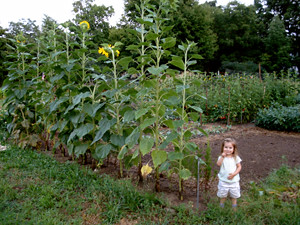
We started by pulling up the early corn stalks and planting cover crop seed in the soil you see behind Abbey and the sunflowers. The cover crop is a "winter" mix of wheat, legumes and clover that will help build the nitrogen in the soil and break up the clay.

Abbey was so into gardening that we got a lot of other chores done too. We weeded, thinned and transplanted some small collards, picked zucchini, cucumbers and broccoli, deadheaded the marigolds, and sprayed the pumpkins and squash with egg water to repel the woodchucks that have been burrowing under the fence and into the garden.

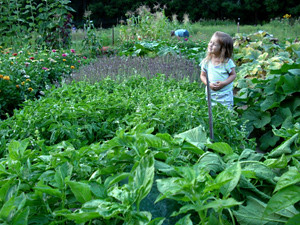
We should be picking the basil that Abbey is standing by, but you only need so much basil. Some of the basil is Tulsi, or Holy Basil, and will be dried for winter tea.

With Abbey's cooperation and help, all the chores were done before the sun dropped below the horizon, so we also had some time to take some picture and to smell the flowers.

Thursday, August 09, 2007

FRESH Idea

Today I got to see a great idea in action. Project FRESH is a nutrition program that does far more than promote nutrition. To be honest, from my perspective as a gardener and a person interested in community building, I think that nutrition just happens to be a side benefit of Project FRESH.

Here's how it works. In the late 1980's, a number of states (including Michigan) decided that it might be a good idea to create a way for low-income folks benefiting from US Department of Agriculture programs like WIC to have access the fresh vegetables and fruits found in farmers' markets.

Today, Project FRESH is a mainstay of the Women, Infants and Children (WIC) nutrition program in many states. The project provides coupons to WIC participants that they can spend at local farmers' markets. Well received by new mothers, the program has been expanded to serve seniors through Senior Project FRESH. At the end of the day, the farmers trade in the coupons for cash.

Sure, this is a creative way to encourage poor people to eat fresh produce, which is a noble idea but an ethic I'm not all that sure I support over giving poor people the same choices as those with cash.

The better part of this program is the way in which these public dollars are multiplied eight times as they:

  1. Feed the poor,
  2. Introduce people to new, local foods,
  3. Financially support small, local farmers,
  4. Help build local food systems instead of trucking under-ripe veggies across the continent,
  5. Introduce consumers to farmers (people who are often not only from different geographical communities, but also typically of different races and ethnicities),
  6. Build community by promoting commercial amenities like markets,
  7. Build more community by creating places where people gather and meet their neighbors,
  8. And bring people back into touch with real food and how it is really grown.
Here in Michigan, Project FRESH is administered by the Michigan Department of Community Health in cooperation with the U.S. Department of Agriculture and Michigan State University Cooperative Extension. Local health agencies and MSU extension offices statewide deliver Project FRESH services in cooperation with the organizers of local farmers' markets.

Earlier this year, I had the opportunity to sell some of my Perkins Garden surplus at the new and emerging Southeast Community Farmers' Market, which recently moved to the corner of Franklin and Fuller in partnership with Divine Grace Ministries and the Greater Grand Rapids Food Systems Council. That Thursday I sold spring greens, early chard and broccoli raab that was sure to bolt while I was away on vacation the next week. While my produce and the market customers were not the best match, I did earn a dozen or so bucks which were tossed into the Food System's community garden fund.

Today I returned with a surplus of about 20 golden zucchinis, 30 cucumbers, four heads of lettuce, a handful of white baby eggplants, and three pints of purple beans. The veggies and the shoppers were a much better match and I only came home with a half dozen cucumbers and the eggplants. I netted more than twenty bucks from produce that otherwise probably would have eventually been sent to the compost pile, The cash itself was composted if you will, returned to the community garden program to make the program more fertile.

But the best part of it was that half of the dollars earned were federal tax dollars that fed the poor, built community, supported local community gardens, strengthened the local food system, and kept one more box full of veggies back in California where they were grown and belong.

In this day of scarce resources, it's good to see federal dollars supporting conservation by building local food systems instead of propping up the old industrial model that relies upon cheap oil from the middle east to ship veggies that can be grown anywhere everywhere.

I count it as a good day when I can see and experience a creative idea like Project FRESH that has the support of both the government and local people. It's an especially good day when the program works as well as this one does.

Monday, July 16, 2007

Passing Time

The posts have gotten pretty infrequent this summer, something I have all the best intentions of rectifying soon.

As you can see, we've been far too busy with important stuff, like flying kites on the beach and growing lettuce.

But in all seriousness, it has been a busy summer with trips to Pictured Rocks and North Carolina. When around home, many weekends have been taken up with either trail work on the North Country Trail or getting caught up at Perkins Garden. June is not a good time for gardeners to go away, as the weeds and the bugs come on with a vengeance around the solstice.

But overall, things are going good out at Perkins. While the corn failed and the cucumber beetles are relentless, the peppers will be early, we've never eaten so much of our own lettuce and spinach, and we picked the first two golden bush zuchinnies tonight.

Basil and beans will be coming out of our ears soon, and the sunflowers are sturdy. I have even started planting some fall greens (collards and spinach), and they too are coming up nicely.

More on the garden soon, I promise...

Monday, May 14, 2007

Unique Garden


Here's the most unique garden I've come across in a while. I tripped across the Garden Barge on the WorldChanging website in a link to a New York Times article about the floating garden.

The recycled old barge (there are plenty of those floating around the Hudson River!) has been retrofitted with solar panels, wind turbines, greenhouses and hydroponic growing medium. It's a cornucopia of cool, high-tech ideas that explore the concept of sustainability.

The project is organized by the well connected and well-funded New York Sun Works.

Now I'm not completely sold on all of the gimmicks on the barge truly being sustainable over the long haul, but it's interesting to see boundaries being pushed.

For another, perhaps more realistic, look at sustainable gardening, check out the work of Ecology Action. This might work better for those of us who don't have access to a barge and a million dollars.

Sunday, May 13, 2007

Time to Eat

The garden at home is in full swing with early crops. The lettuce is just beautiful this year.

Earlier this week, we picked our first lettuce and some early chard. Tomorrow we will also be picking spinach (middle of this picture below, taken two days ago), and the broccoli raab is not far behind.

I have been having a slight problem with some invisible, nocturnal pest. It seems like this pest is most fond of seedlings before their true leaves sprout, so often the plants recover. But he or she seems to also really like broccoli raab and kale that is larger. Whatever it is, it doesn't seem very fond of lettuce or spinach.

I set out slug traps, but they only proved to be a waste of perfectly good beer.

After posting this, I'll be going out to the garden to take another look for the culprit. I'll let you know if I find anything.

Sunday, May 06, 2007

I See Some Work on the Horizon

I stopped by Perkins earlier this afternoon to water some seedlings and was surprised to find that the entire plot had been tilled! Just breaking up the heavy soil at Perkins on a sunny weekend has resulted in a much drier garden.

But it will be a week at least yet before I can start getting things planted out there. We plan to till the garden a second time in about a week so that the soil is more workable for planting. If it stays dry, we may be able to plant before the projected date of May 18. I sure wouldn't mind getting some early corn in.

Last week, I planted some lettuces, spinach, broccoli raab and chard, and all are coming up except the chard. I hope to put in some snow peas at Perkins this week.

Sunday, April 29, 2007

A Hard Day's Work

More species tulips are blooming in the garden now that we're back to spring. If you've never grown species tulips, you really should give them a try. They are much more satisfying than the big hybrids.

Species tulips will multiply and naturalize on their own, and come back beautifully year after year. They are little trouble and always give a good show.

One really nice thing about them is that they really catch the eye of people passing by. Like this little pink tulip, which always gets comments from visitors who are used to seeing the same old hybrids again and again.

So far I have five different varieties, one of which has yet to bloom this spring.

But the tulips aren't the only ones up. The peas and favas all sprouted this week. Carrots, radishes and various greens are all on their way too.

Early this afternoon, Abbey helped me plant bush beans and chard. I planted the mustard, as the seeds are far too small for little hands. I also planted some early basil in the cold frame, more cilantro, and some arugula seed that a woman shared that came directly from her father's garden in Italy.

After getting some of the beds at home dressed up, we all went out to Perkins to work on getting some more of the fence put up. During last weekend's work party, we sank more than a dozen posts and got a lot of things ready, but we still have to fence in the early spring beds.

It was a beautiful day for working in the garden... and also a good day for goofing of in a wheelbarrow. But Abbey didn't just goof off, she also explored the main garden with her mom and found some herbs struggling to grow in an abandoned plot from last year. They found some thyme, sage, parsley and one other unknown herb that I'll have to identify after it grows a bit.

After getting some of the fencing done, I double dug a section of the garden and put in two 4'x4' raised bed frames that were also abandoned last year. I filled the frames with a mix of vermiculite, compost and garden soil, then planted them with Allstar lettuce mix, Nancy buttercrunch lettuce, Space spinach, Bright Lights chard and broccoli raab.

We got done a little late, but here's a picture of Julie and Abbey surveying a hard day's work and hoping for a little rain.

Saturday, April 21, 2007

Green Things

With the white stuff from last week gone, the green stuff is starting to perk up again and get serious about growing. The peas I planted three weeks ago are still pretty dormant (only an few have attempted to sprout) and the favas and carrots haven't done a thing. But I guess with temps in the 20's and 30's for most of the first week and a half, it's no surprise.

But this broccoli raab is getting serious about sprouting, as is the leaf lettuce, buttercrunch lettuce and spinach. The garlic is on the rebound too. The forecast for the next few days is calling for sun and more warm temps, so the bare beds of soil should really begin looking more like vegetable gardens soon.

Inside the gold frame, things are even happier. As I tend to the plants in there, I get to wondering what the sprouts talked about for the three or four days they were snuggled in the cold frame under a couple of inches of snow. Enough light must have filtered through to keep photosynthesis happening.

After last year's bumper crop of chard, I'm not sure why I planted more this year. Perhaps it was because I really wanted to see the beautiful mixed colors of this Bright Lights variety.

Leaf lettuce is also good for cold framing. This short row will be ready for trimming for baby greens by next weekend. Without the cold frame, I was harvesting my first greens around Memorial Day. This year they'll be consumed before April is over.

Outside the cold frame, the species tulips and early daffodils really took a hit from being under the snow for so long. But I have some miniature narcissus that took it all in stride and began popping open yesterday.


Sunday, April 08, 2007

Indoor Gardening

Our foretaste of spring flew the coop midweek last week and we returned to winter, complete with wind, subfreezing temperatures, and snow. While the cold frame has stayed above freezing inside thanks to the thermal mass and organic activity of the live soil, the rest of the garden is on hold.

To keep seedlings moving along, I took inside the flat of cold-weather crops I was starting in the cold frame.

  • Seeds of Change Red Drumhead cabbage (2006 seed)
  • Johnny's Early Green Lynx cabbage
  • Pinetree Cheddar cauliflower (2006 seed)
  • Pinetree Nutri-Bud broccoli (2006 seed)
  • Johnny's De Cicco broccoli
A trick I have learned in our cold house is to put the flats of seeds in the oven with the light bulb on to sprout the seeds. The oven light raises the temperature inside the oven 5-10ยบ over the air inside the house.

Now the seedlings are sitting in a south-facing window sill in a cool, upstairs room (yes, that is snow outside). The forecast calls for warmer temperatures this week, so they should be moving back to the cold frame by midweek.

Of note to Grand Rapids gardeners is my discovery of Growco Indoor Garden Supply, a supplier of hydroponic growing supplies in Grand Rapids. They have a great selection of organic controls, nutrients and growing medium, including great, fortified soil for seed starting. And as you might suspect of one who peddles in grow lights, hydroponics and the like, their main entry door is around back of the building and mail order is sent in plain, unmarked envelopes. For interested locals, they are located on the south side of Michigan Street, across from Rylee's Ace Hardware, just west of Fuller Ave. To the serious organic gardener, their products far exceed what is available from the big box guys and other garden supply stores.

Monday, April 02, 2007

Monday Night Planting

Yesterday's rain showers never ended until late in the night, so the peas had to go in today. I planted three seven foot rows of Caseload shell peas and two four and an half foot rows of snow peas. Suffice it to say that the peas went further than I expected.

Between the rows of shell peas, I planted:

  • a mix of Seeds of Change Bronze Arrow and Black-Seeded Simpson leaf lettuce.
  • Johnny's Scarlet Nantes carrots
  • Johnny's Cosmic Purple carrots (yes, they're really purple!)
  • two-year old leftover French Breakfast radish seeds from Pinetree Garden Seeds.
The monardia I planted from seed last year is coming back nicely. I planted this monardia specifically for tea, rather than for bloom. The picture above shows the new spring growth.

Sunday, April 01, 2007

Seed Sowing

As she gets older, Abbey is becoming a bigger and bigger help in the garden.

This afternoon was warm and sunny, but windy. So Abbey helped out by holding onto my seed packets so that they would not blow away. She watched patiently as I planted the smaller seeds.

Today I planted:

  • Johnny's Allstar lettuce mix
  • Johnny's Space spinach
  • Johnny's Nancy butterhead lettuce (pelleted)
  • Johnny's broccoli raab
  • Johnny's Red Russian kale
  • Johnny's Windsor fava beans
When it came to the fava beans, Abbey wanted to help put the beans in the soil. So I hoed the furrows, Abbey helped my coat the beans with inoculant, and she helped me put them into place.

Fava beans are a good seed to plant with kids because they are so big, go in an obvious furrow, and are well spaced.

This afternoon, a few showers rolled in so I stopped planting, but I've got furrows ready to go for two rows of shell peas and my fist sowing of snow peas. If it stops raining, I'll get those in this evening too. The varieties I selected this year are:
  • Johnny's Caseload shell peas
  • Johnny's Snow Green snow peas
Between the rows of peas I'll plant carrots, lettuce and radishes so as to not waste the space. I hope to get to those tomorrow night.

Keeping us company as we planted were these wide-eyed species tulips. These are the same tulips as featured on March 27, just wide-open because of the bright sun.

Tuesday, March 27, 2007

True Leaves

A couple of warm days and the broccoli raab is now sprouting true leaves. Some critter has nibbled a few of the plants, and I had complete failure of germination with my spinach seeds. My best guess is that the cold frame got too warm inside and steamed the spinach sprouts.

I'll try again on the spinach by direct seeding some into the garden tomorrow night if it doesn't rain.

Friday, March 23, 2007

Grand Rapids Community Gardens

To promote community gardening in Grand Rapids, I have joined with a few other gardeners to form the Grand Rapids Community Gardens blog.

Admittedly, some of the blogs will be a little reminiscent of what's found here.

A number of people have expressed interest in blogging, so you should see a few more names in the coming weeks. But right now it's just me an Travis Childs. Check out his most recent entry.

Wednesday, March 21, 2007

A Good Way to Start Spring


The dozens of crocuses blooming on the east side of the garage tell me that spring is certainly here. Tonight they stayed open into the warm evening hours.

The weather is also affirming the change in seasons. Today we got our first thunderstorm of the year on the very first day of spring. I couldn't think of a better way to celebrate the start of this season of renewal and growth.

The thunderstorm rolled in just after dark, so Abbey and I turned off all the lights in the house, opened up the back door, and watched, smelled and listened. We stood witness to nature's annual trick of fixing a little nitrogen in the soil and talked about our eagerness for the new season to green things up.

The curiosity of a nearly three year old seems insatiable at times. "Why does it do that Daddy?" Try explaining spring warm fronts, rain, lightening, thunder and the re-emergence of the garden to a child of her age. Doing so made me, as an adult, wonder just how and why the magic of a spring thunderstorm is actually possible.

I'm thankful for the way in which little eyes can help older ones see things in new ways.